Christmas Socks - Redwork Embroidery
A Thoughtful First Impression for Boutique Apparel Designers
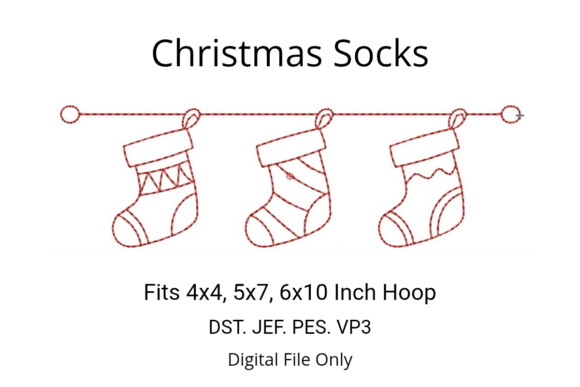
As an embroidery designer who’s developed collections for small clothing brands and Etsy sellers over the past decade, I opened Christmas Socks - Redwork Embroidery expecting charm—but what stood out immediately was its confident simplicity. This isn’t a fussy, over-digitized holiday motif. It’s clean-lined, hand-drawn in spirit, with intentional negative space and balanced weight distribution across each sock shape. The redwork style gives it warmth and authenticity—rustic yet refined—making it feel equally at home on a vintage-inspired denim jacket or a minimalist oatmeal hoodie. It reads as classic, not trendy, which means it won’t date your boutique brand’s seasonal lineup.
How Christmas Socks - Redwork Embroidery Performs on Real Garments
I tested Christmas Socks - Redwork Embroidery across six fabric types commonly used in small-batch apparel: midweight cotton sweatshirts, French terry hoodies, 100% cotton tees, fleece-lined joggers, structured denim jackets, and natural canvas totes. On neutral sweatshirts (heather grey, cream, soft black), the design pops without overwhelming—especially at the 5x7 hoop size, which strikes the ideal balance between visibility and subtlety for chest placement. At 4x4, it works beautifully as a sleeve accent or pocket detail on oversized hoodies. The 6x10 version anchors well as a back design on crewnecks or relaxed-fit sweatshirts, adding seasonal character without sacrificing wearability.
For t-shirt embroidery, I recommend using the 4x4 or 5x7 sizes only—and always with lightweight cutaway stabilizer. The stitch density is moderate, not heavy, so it moves gracefully with the fabric rather than stiffening it. On dark garments, contrast improves dramatically with high-sheen 40-weight rayon or premium polyester thread; matte cotton thread can mute the redwork’s crispness. With ribbed fabric or stretchy knits, avoid placing the design directly over high-movement seams—opt instead for flat, stable zones like upper chest or lower back.
Strategic Placement for Sweatshirt Embroidery & Hoodie Design
When planning a holiday capsule collection, Christmas Socks - Redwork Embroidery shines in three distinct roles: as a signature chest emblem for branded sweatshirts, as a coordinated sleeve motif across a unisex hoodie set, and as a subtle back collar accent on oversized crewnecks. Its symmetry and centered composition make it forgiving for alignment—even on curved surfaces like hoodies with shaped yokes. For boutique brands building visual consistency, this design delivers cohesion across product categories without needing custom layout tweaks.
On tote bags and lifestyle merch, the 6x10 version adds just enough presence to read clearly in social media graphics and printable mockups—critical for Etsy listings where first impressions happen in under two seconds. And because it’s a single-color redwork motif, it photographs cleanly against textured backgrounds (think linen napkins, wool throws, or wood grain) — boosting your product recognition in lifestyle product photos.
What Makes This Creative Fabrica Embroidery Stand Out Commercially
Unlike many holiday-themed machine embroidery designs that lean cartoonish or overly ornate, Christmas Socks - Redwork Embroidery supports long-term brand identity. It doesn’t scream “seasonal clearance”—it whispers “thoughtfully made.” That nuance builds buyer trust, especially among customers who value handmade product integrity over mass-produced novelty. For Etsy sellers and small shop owners, that quiet confidence translates directly into perceived value: you’re not selling a holiday trend—you’re offering a curated, repeatable element of your aesthetic.
Its inclusion of three hoop sizes—4x4, 5x7, and 6x10—is practical, not performative. You’re not forced into one-size-fits-all digitizing compromises. Each version maintains proportion and clarity, meaning your sweatshirt embroidery stays sharp whether stitched on a child’s pullover or an adult XL hoodie. And because the file includes DST and JEF formats, it integrates smoothly into most commercial embroidery workflows without conversion hiccups.
Practical Notes Every Embroidery Designer Should Check
- Test on scrap fabric first—especially if working with fleece, brushed cotton, or ribbed knits. Redwork relies on clean line definition, and texture can blur edges.
- Confirm stabilizer choice: lightweight cutaway for stable knits; tear-away with light spray adhesive for wovens like denim or canvas.
- Review thread color contrast before bulk production—redwork gains impact with rich, saturated reds (like Madeira Polyneon #4980 or Sulky Rayon #1131), but softer tones work beautifully on pastel hoodies.
- Verify hoop size compatibility with your machine’s maximum stitching area—don’t assume 6x10 fits unless confirmed.
- Inspect stitch density visually in your embroidery software: look for smooth transitions between curves and no overcrowded fill areas that could cause puckering on stretchy fabric.
- Compare placement options on garment mockups—not just flat templates—to anticipate how the design flows over darts, seams, and body contours.
- Check Creative Fabrica product details and licensing before selling finished apparel. Confirm whether the license permits commercial embroidery use for resale, especially if you’re producing for clients or your own boutique brand.
Final Thoughts for Creative Entrepreneurs
Christmas Socks - Redwork Embroidery isn’t just another holiday download—it’s a versatile, design-forward asset for apparel decorators who prioritize intention over impulse. Whether you’re launching a limited-edition cozy collection, refreshing your Etsy store’s seasonal offerings, or building a cohesive line of custom apparel for local boutiques, this embroidery file earns its place in your digital library. It performs reliably, photographs beautifully, and carries a quiet craftsmanship that resonates with discerning buyers. In a market flooded with generic motifs, it’s the kind of detail that makes customers pause, recognize quality, and remember your brand—not just the season.