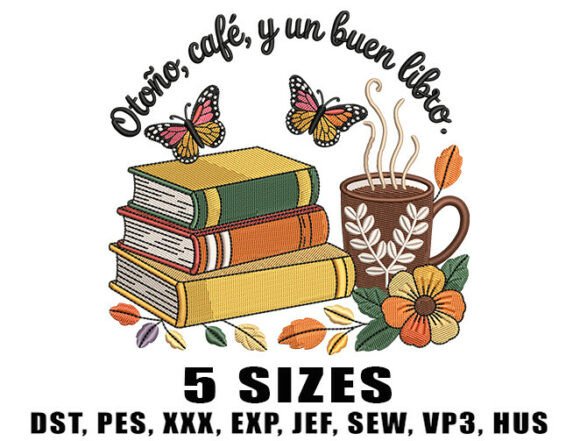
Spanish Autumn Book Embroidery Design
First Impression: Cozy, Cultured, and Instantly Recognizable
As an embroidery designer who’s curated over 200 craft fair booths in the past decade, my gut reaction to Spanish Autumn Book Embroidery Design is immediate: it’s warm, intentional, and quietly sophisticated. The phrase “Otoño Café y Libro” lands with a soft but confident rhythm—evoking rustic cafés, handwritten journals, and slow autumn mornings. It’s not loud or trendy; it’s curated. That makes it ideal for buyers who scroll past generic pumpkins and flannel motifs searching for something that feels personal, literary, and gently bilingual. It reads as elegant—not overly ornate—but decorative enough to command attention on a crowded table.
Where This Design Shines in Real Craft Fair Products
This isn’t a one-size-fits-all motif—it thrives where storytelling meets utility. Here’s how it performs across key handmade categories:
- Tote bag design: Excellent focal point when centered on natural canvas or oat linen. The Spanish text adds quiet distinction versus English-only fall slogans—especially appealing to educators, book lovers, and bilingual shoppers.
- Apron embroidery: Perfectly balanced above the pocket or subtly stitched along the waistband. Feels artisanal, not kitschy—ideal for coffee roasters, indie bakeries, or boutique kitchen shops.
- Tea towel embroidery: Works best on medium-weight cotton or linen-look towels. Avoid ultra-textured terry—we’ll revisit that in careful-use notes. When placed in the lower corner, it elevates a simple kitchen staple into a giftable handmade product.
- Embroidered patch: A standout choice. The compact composition (books + coffee + butterflies) translates beautifully into a 3–4" round or oval patch. Great for jackets, denim totes, or kids’ backpacks—adds personality without overwhelming.
- Fabric pouch & pillow cover: Highly effective at mid-to-large sizes. The butterflies lend gentle movement; the coffee cup grounds the design. Customers consistently pause longer at pillows with this kind of layered, mood-driven machine embroidery design.
- Caps & curved surfaces: Use caution. While charming in concept, the small lettering and delicate butterfly wings may distort on rigid caps unless digitized with curve compensation. Best reserved for structured beanies or flat-front trucker caps.
What Makes It Sell—And What Makes It Stick
At a craft fair, attention spans are measured in seconds. Spanish Autumn Book Embroidery Design wins because it’s legible at 6 feet, emotionally resonant, and visually cohesive across product types. It doesn’t require explanation—it invites curiosity (“Otoño? Oh—autumn! I love that word.”). That subtle bilingual nudge builds connection without alienating non-Spanish speakers.
For Etsy sellers and small shop owners, it’s also highly repeatable. With five included sizes, you can batch-produce matching sets—tea towel + pouch + patch—and list them as coordinated Autumn collections. That consistency strengthens brand perception and boosts average order value.
Photography is another win: the design renders cleanly in natural light, holds contrast well on neutral fabrics, and avoids muddy gradients. That means your printable mockups and Instagram posts look polished—even without professional editing.
Careful-Use Notes Every Embroiderer Must Check
Don’t assume charm equals ease. As a working embroidery designer, I’ve seen this design lose impact—or worse, stitch out poorly—when overlooked details aren’t addressed:
- Dense stitch areas: Butterflies and book spines often pack fine satin stitches. On thick fabric (like denim aprons or canvas market bags), test stitch density first—you may need to reduce fill density by 10–15% or switch to tatami fill for breathability.
- Tiny details: Those butterfly antennae and coffee steam lines are adorable—but fragile. Avoid scaling below 2.5" unless your embroidery file explicitly confirms legibility at that size.
- Small lettering: “Otoño” contains a tilde (~)—a detail easily lost in low-res digitizing. Verify the accent appears crisp in your test run. If it blurs, request a revision from the seller before bulk production.
- Textured towels & dark fabric: Heavy-loop tea towels demand extra stabilizer (cutaway + tear-away combo works best). On charcoal or navy fabric, confirm thread colors provide sufficient contrast—especially for thin script elements.
Designer-Level Production Checklist
Before cutting your first fabric piece, run through these non-negotiable steps:
- Test the machine embroidery design on scrap fabric matching your final product’s weight and texture.
- Check thread contrast under both daylight and booth lighting—some golds or creams disappear on beige linen.
- Review spacing between letters and motifs—tight kerning can cause thread nesting; generous spacing improves readability.
- Confirm hoop size compatibility with your machine and intended product (e.g., a 5×7 hoop won’t fit most cap fronts).
- Inspect stitch density in the butterfly wings and coffee steam—over-stitching causes puckering.
- Use appropriate stabilizer: cutaway for knits, tear-away for stable wovens, heavy cutaway for textured towels.
- Create at least one real mockup—not just digital. Hold it in hand, walk around your booth space, see how it catches light.
- Compare fabric colors side-by-side: oat, cream, slate, and terracotta all change how “Otoño Café y Libro” reads.
- Confirm commercial licensing applies to finished products—especially if selling embroidered patches or wholesale items.
Final Thought: A Quiet Anchor for Your Autumn Line
Spanish Autumn Book Embroidery Design isn’t flashy—but that’s its strength. In a sea of glittery gourds and monogrammed scarves, it stands out by being thoughtful, tactile, and culturally grounded. It elevates every craft fair product it touches—not with volume, but with voice. For embroidery business owners building a recognizable aesthetic, this is more than a seasonal design. It’s a signature piece: soft enough for a handmade gift, refined enough for a boutique shelf, and versatile enough to carry your brand through multiple Autumns.